
About me...
Get to know your instructor a little better before our course begins in earnest

Many of my followers have taken classes with me, but I hope to attract new students and wanted to use an early post to introduce myself while I figure out how to make an About page. After today, plan to receive posts once a week, though this may change depending on reader feedback.
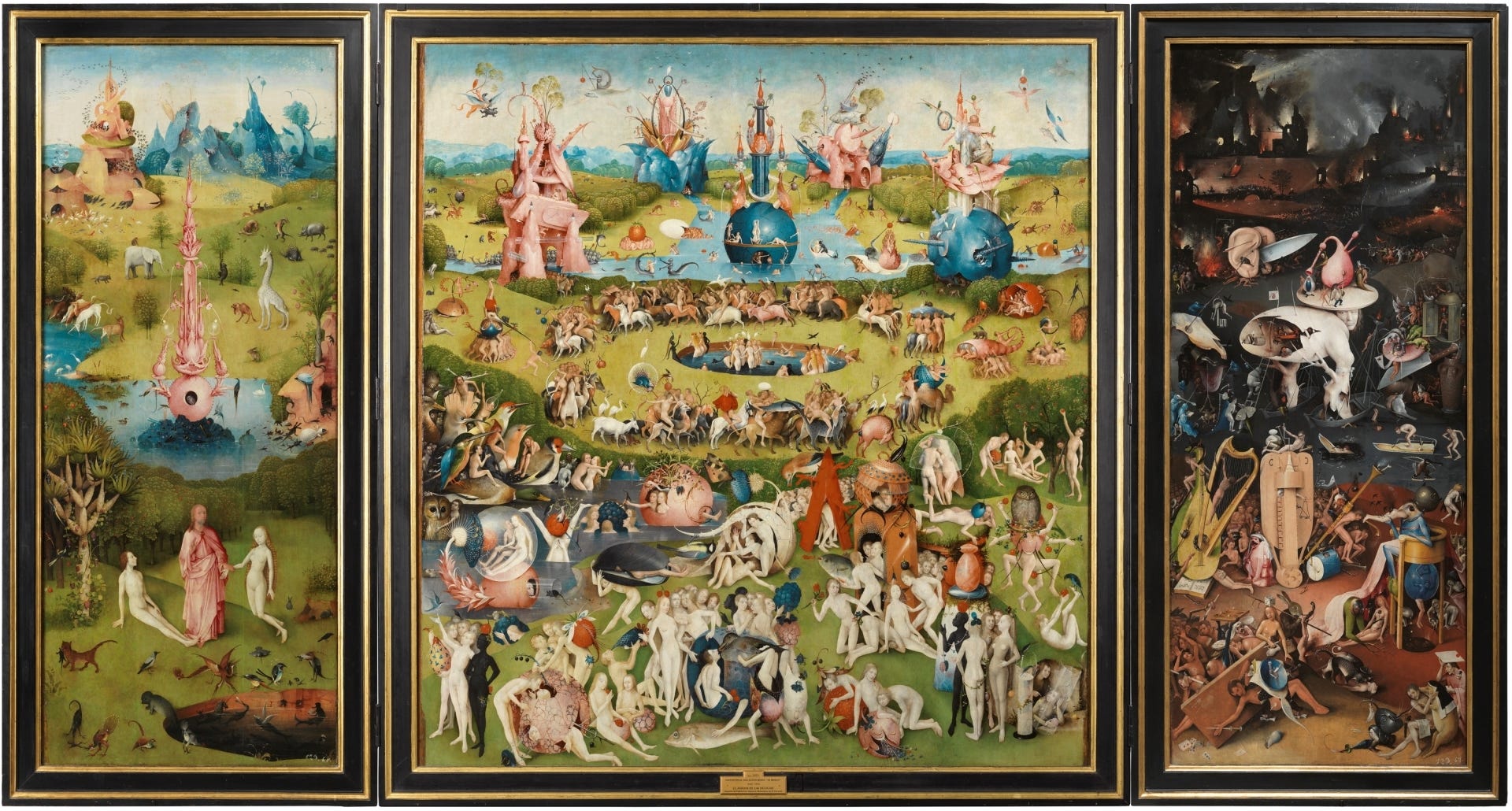
So, about me: After completing a joint history / art history major at Emory University, graduating magna cum laude with the thesis “A Historiography of Hieronymus Bosch’s Garden of Earthly Delights,” I moved to New York City to begin graduate studies at the Institute of Fine Arts (IFA), part of New York University, in 1993.
The IFA program offered the opportunity to explore a wide range of courses with a large faculty of experts, and in 2000 I earned my PhD in the History of Art and Archaeology after completing my master’s in 1995. My major field was Southern Renaissance Art and Architecture, with minor fields in Roman; Southern Baroque; and Northern Renaissance Art and Architecture.
The degree requirements have changed in the intervening years, and my major and minor fields have been reorganized and renamed. Students now must complete ten courses rather than the nine I took,1 two of which are new, required foundations courses that would have benefitted me greatly!
Foundations I: … an advanced introduction to the discipline and methods of art history, driven by members of the Institute faculty. Taking up the view that art history is not a fixed, unitary discipline but rather a multifarious field of study, the course introduces the students to some foundational concepts and historical developments that shape art history's various specializations. [The course recently] considered the multiple facets of art history through the thematic lens of "Unfinished Business." What are the grounding problems, questions and presuppositions that our subfields inherit and continue to grapple with? What does this inheritance demand of art historians in their current endeavors? Members of the faculty respond[ed] to these queries in elucidating key problems in art history from the standpoint of their methodological concerns. Each presentation also serves as an introduction to the Institute’s diverse research foci. The course is intended to provide incoming M.A. students with a basis for their coursework and research over the two years of the program, and a foundation for critical reflection in all future work.
Yes, that would have been helpful, not to mention intense! I am excited for current and recent IFA students who, from the get-go, are asked to think about the semantics of art history as well as works of art themselves. (I spoke a little about the problems with the names and categories we use to describe the history of art in Why Western Art?, and this is a theme that will recur throughout our discussions).
The categories of art from which I fulfilled my distribution requirements have also changed dramatically in the quarter century since I was at the IFA. My major and minor fields now fall under the rubrics “The Ancient Mediterranean and Middle East, Including Egypt” and “Pre-modern Europe and the Americas.” Were I a first-year student today, I would choose courses in the following distributions, with at least four of the required eight selected from different areas:
Pre-Modern Asia
Pre-modern Africa and the Middle East
Post-1750 Global
Museum and Curatorial Studies
Technical Studies of Works of Art
Architectural History
The names may have changed, but I am happy to report that my transcript would earn me an MA today, though my two qualifying papers — one on Edouard Manet’s trip to Spain and the other on Michelangelo’s Last Judgment — would be very difficult to rewrite as a single MA thesis. Continued studies concentrated on Italian art, architecture, and museology culminated with my dissertation “The Florentine Badia: Monastic Reform in Mural and Cloister.”
After teaching undergraduates and MA candidates at four American colleges and universities, I am very happy with my status as a Visiting Scholar at the University of Virginia in the Institute for Advanced Technology in the Humanities (IATH) and my role as an occasional instructor for lifelong learning students at Auburn!
So now, I’m delighted to start this new Substack adventure through the history of Western art with you (oops, I mean Ancient and Pre-modern Europe and the Americas).
For paid subscribers: read on for more about my research background, publications, the origins of Digital Sepoltuario, and how I came to study memorial culture in Florence. You’ll also be able to ask questions or leave comments.
As I mentioned above, I am a Visiting Fellow at the University of Virginia’s Institute for Advanced Technology in the Humanities (IATH). This sometimes confuses people because I live in Auburn, Alabama, where I occasionally teach the history of Western art to a great group of lifelong learners. I also spend a good amount of time in Florence, Italy where I conduct my original research.
Through UVA, I curate Digital Sepoltuario, an interactive website that chronicles the memorial landscape of medieval and Renaissance Florence through an illustrated digital catalogue of tombs, altars, chapels, and other memorials installed in Florentine churches from the mid-thirteenth through the late eighteenth centuries.
In January 2025 I gave a talk at OLLI at Auburn that presents an overview of this project:
The Digital Sepoltuario team has received generous funding from numerous entities, including the
National Endowment for the Humanities
Richard Lounsbery Foundation
Kress Foundation
Gladys Krieble Delmas Foundation.
My original research on Florence’s memorial culture has also been supported by Harvard University, the American Philosophical Society, the Renaissance Society of America, the Savannah College of Art and Design, and ARTstor.
And, now, thanks to your paid subscription, by this Substack!
The Digital Sepoltuario project started while I was the 2008-2009 Rush H. Kress Fellow at Villa I Tatti, The Harvard University Center for Italian Renaissance Studies. While there I first completed my monograph The Badia of Florence: Art and Observance in a Renaissance Monastery (Indiana University Press, 2012) and then began work on Digital Sepoltuario.
I have also edited and contributed to Memorializing the Middle Classes in Medieval and Renaissance Europe (Medieval Institute Publications, 2018), and my work has appeared in several essay collections and exhibition catalogues. My articles and reviews can be found in a variety of journals including The Burlington Magazine, The Journal of the Society of Architectural Historians, Renaissance Quarterly, Renaissance Studies, Speculum, and Studies in Iconography, and most are available for free online at Academia.edu. If there is anything not posted there due to copyright embargo, don’t hesitate to contact me and request a copy!
My publications explore a range of topics in medieval and early modern art, architecture, urbanism, and religious tradition in Italy. I’m especially interested in sacred art and architecture, specifically in how images and buildings were used by individuals and institutions for devotional practice, doctrinal instruction, propaganda, and social status. I have extensive archival experience, having worked with medieval, Renaissance, and early modern manuscripts and other materials in various Italian archives and libraries.
I founded and edited IASblog from July 2013 to July 2016 at italianartsociety.tumblr.com for the Italian Art Society as a fun way to interest readers in the art and architecture of Italy from prehistory to the present. Unfortunately, tumblr is not the platform it was back in 2013, but the blog lives on at the Society’s website https://www.italianartsociety.org/category/blog/.
I have also done curatorial work for the Museum of Fine Arts Houston, The Metropolitan Museum of Art, the Richard Gray Gallery, the Frist Center for the Visual Arts, and the Isabella Stewart Gardner Museum.
Born in Houston, Texas; educated in Atlanta, Georgia and New York City; and employed in Durham, New Hampshire; Union, New Jersey; Manhattan (NY), and Atlanta, Georgia, I moved to Auburn, Alabama in 2013 and have worked as an independent scholar ever since, becoming a non-resident visiting fellow at UVA in 2016.
I have taught an introduction to the principles of art history in a variety of ways: as a one-semester global history from cave paintings to contemporary art to more in-depth surveys of art and architecture from a Western perspective. For this Substack I have gone back to the very beginnings to think about when humans first developed an aesthetic sensibility and what our earliest known artworks tell us about why we continue to make and appreciate art today. Next week we will explore the question: “What makes something a work of art?” Until then, happy looking!
To my credit, some things were more challenging back in the day. For example, MA students now must demonstrate reading proficiency in only one modern language other than English. We had to pass both French and German exams as well as be proficient in whatever ancient or modern languages were relevant to our studies. My dissertation research required reading in German, Latin, Italian, and Portuguese. But, don’t be too impressed, my Portuguese was entirely based on fluency in Spanish and Italian and a very good Portuguese-English dictionary; my German, despite passing the reading test in January 1994, was and is dismal. My Latin is a lot better now than it used to be, thanks to wonderful short and term Latin courses offered online by the Warburg Institute in London. Of course, now we have Google translate and AI, but they are not always trustworthy or able to read lengthy texts.