

You’re reading a post from “A History of Western Art,” a series in the newsletter Art History with Anne Leader. Subscribe to follow the series from cave paintings to Christo and receive new illustrated essays every Tuesday morning.
Archaeological interest in the two great civilizations that emerged from the alluvial plains of the Nile, Tigris, and Euphrates has a long history in the West, where a desire to find the ancient cities of the Bible (such as Nineveh and Babylon) has led to intense study of Ancient Egyptian and Near Eastern cultures. Through a series of English and French archaeological expeditions to the region, the art and architecture of Mesopotamia and Egypt became crucial parts of the Western canon, even though neither is in a region considered to be the “West.”
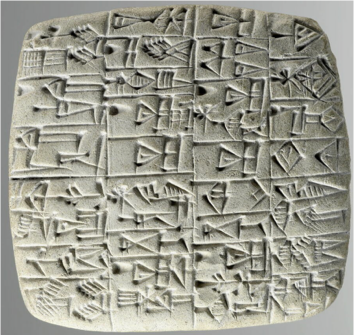
Thanks to thousands of inscribed clay and stone tablets like the one shown above, we know a lot about ancient Mesopotamia (Greek for the “land between the rivers”), with a level of detail and accuracy impossible for the Paleolithic and Neolithic periods. As humans began to settle in fixed locations during the Neolithic period, great changes came to the human experience when small communities became towns and cities, and cultural identities and common languages and belief systems led to what we would consider civilization.
civilization: the stage of human social and cultural development and organization
that is considered most advanced
Many great “firsts” are attributed to Mesopotamia, though ongoing research continues to complicate and revise the West’s claims for primacy. In Mesopotamia we see the invention of the wheel, which led to the development of vehicles, and the plow, which allowed farmers to plant more crops and ensure their healthy growth through irrigation and drainage systems. Ancient Mesopotamia was home to early investigations in math, science, and astrology. Concepts of legal rights, such as the famous “eye for an eye,” also come out of the Fertile Crescent.
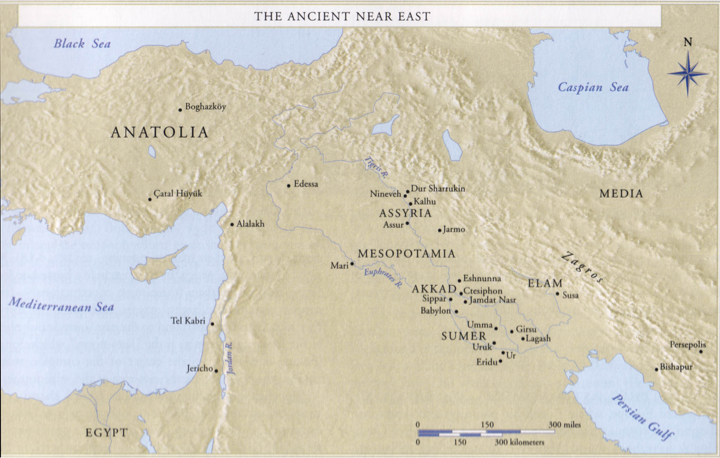
However, the fertile soil of the wide river valley, while responsible for the region’s wealth and strong agricultural economy, had few natural defenses. Ancient Mesopotamians were vulnerable to repeated invasions and internal conflicts between rival powers. The history of Ancient West Asia is one of shifting centers of power and the rise and fall of cities, rulers, and empires such as Sumer, Akkad, Babylonia, and Assyria.
Ancient Sumer was the earliest known civilization in Mesopotamia, thriving from about 4500 to 2000 BCE. As farming and animal husbandry became more sophisticated, and food surpluses became the norm, more and more people left the land and took on new roles in government, religion, commerce, and culture. The Sumerians transformed their flat, broad river valley at the confluence of the Tigris and the Euphrates with great urban centers, each organized around man-made mountain-like platforms that held their temples up toward the heavens.
Thanks to their invention in the 4th millennium BCE of the earliest known form of writing, we are able to reconstruct much of their day-to-day lives and their concepts of community and collective responsibility.1
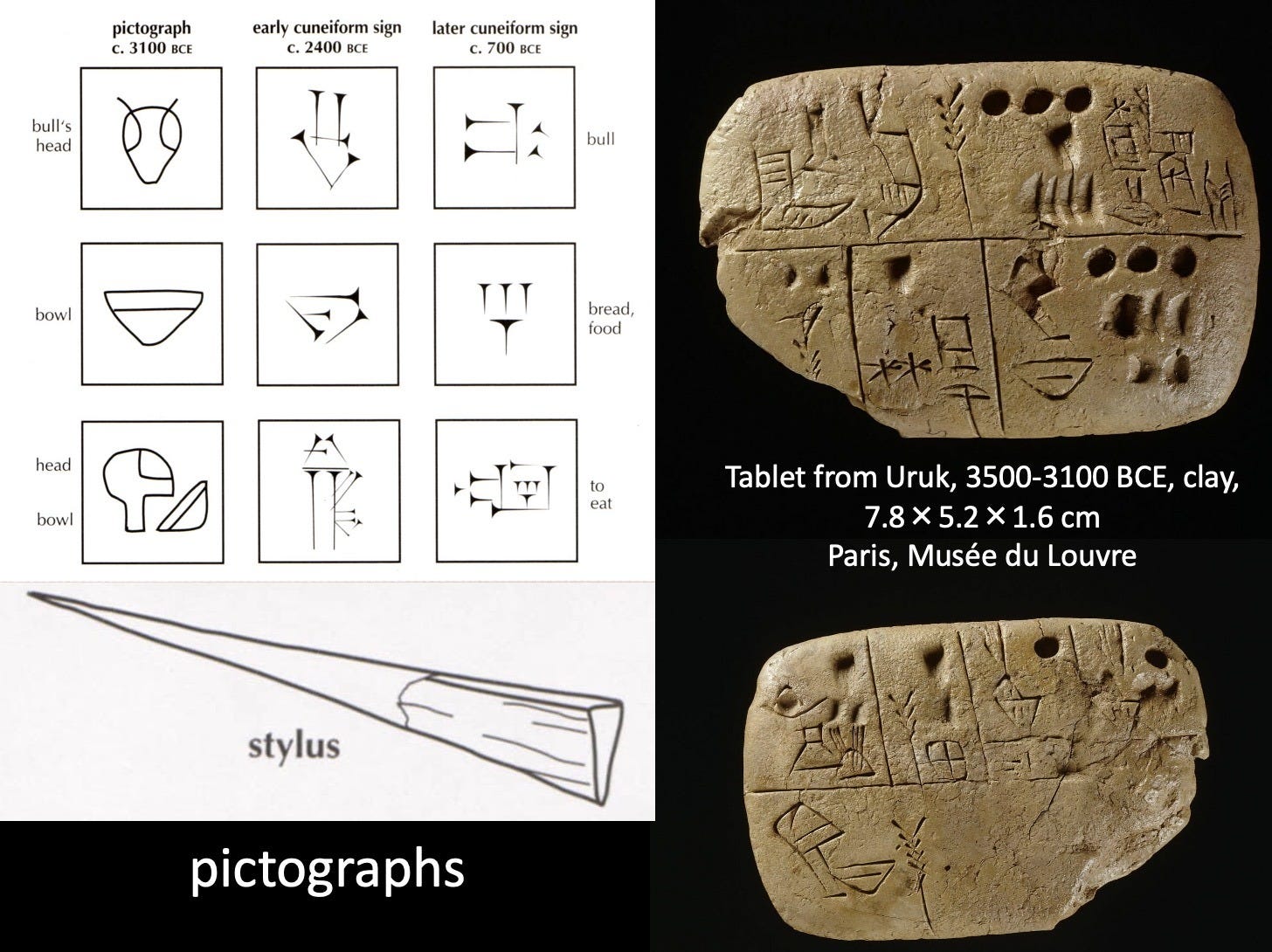
The earliest writings from Ancient Sumer used simplified symbols, or pictographs, that were etched with a sharp tool known as a stylus. Over time, these images were further abstracted into wedge shapes arranged into different configurations to signify words and concepts. The pictograph tablets, like the double-sided one from Uruk shown above, are separated into grid squares read in sequence from top to bottom and often from right to left. This particular tablet records quantities of food, specifically barley rations, with numeration represented by the hole-like indentations. We can use the chart at the left to find the bowl in the lower right of the upper view, signifying food, while the pictograph for eating is seen on the lower left of the opposite side.
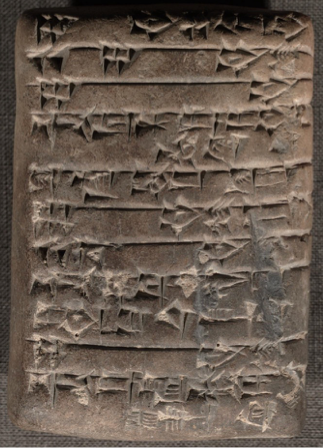
Over time, Sumerian scribes developed a more efficient way of writing by making wedge-shaped dents in wet clay with a reed-stylus. This abstracted form of writing is known as cuneiform (from the Latin cuneus, meaning ‘wedge’). Thousands of cuneiform tablets attest to the trade and travel of ancient Sumerians. In addition to inventories and sales transactions, the Sumerians wrote poetry and prose, the most famous being the 3,000-line Epic of Gilgamesh, which tells the story of the king of Uruk, who, after making mischief with his companion Enkidu, goes on a quest for immortality.
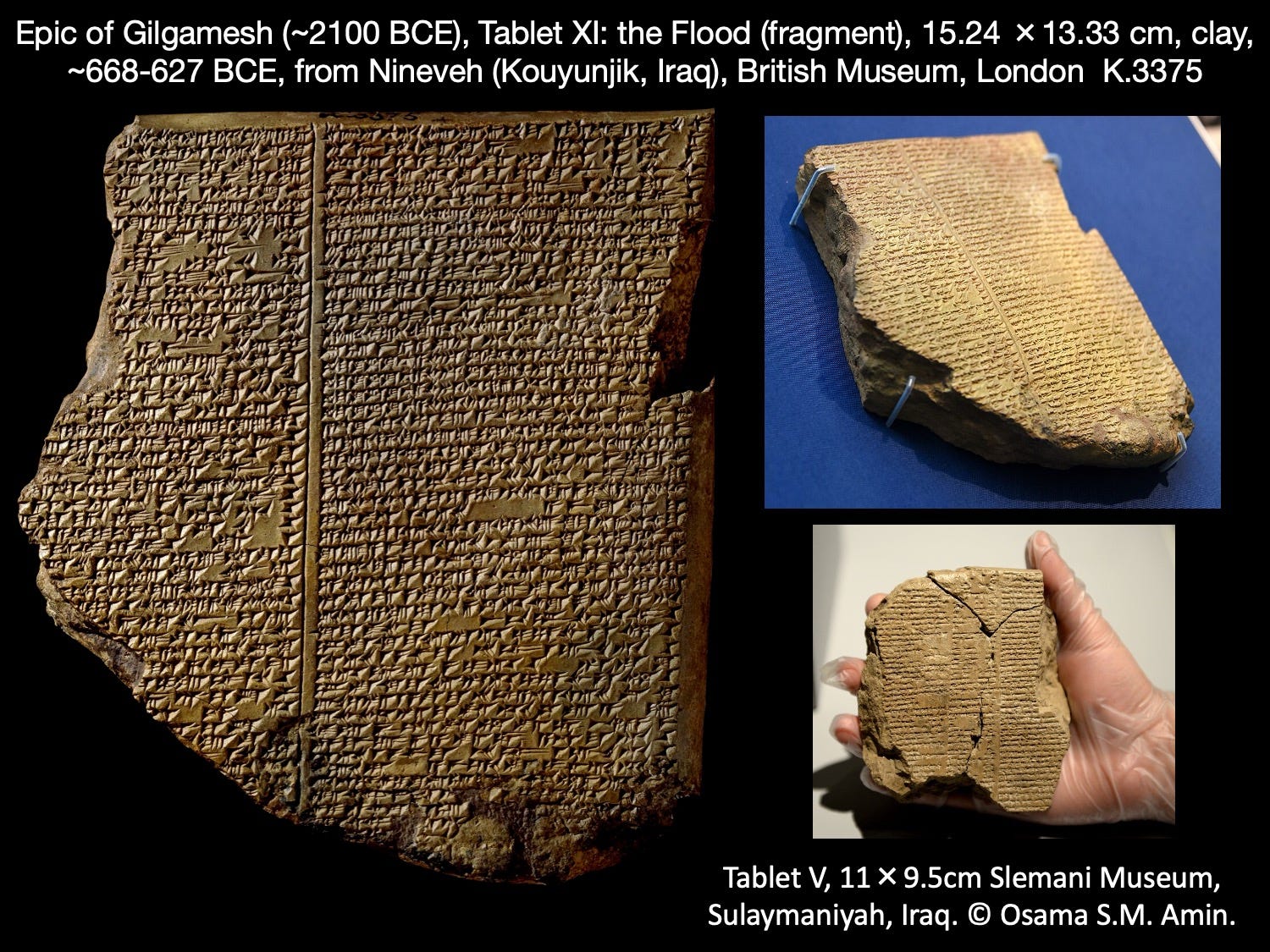
Though much of the poem has been known and understood since the 1870s through tablets kept at the British Museum (above left and upper right), a tablet with the story of the great flood discovered in Iraq was acquired, translated, and published by the Slemani Museum between 2011 and 2014 (above lower right). This discovery expanded the poem and has led to a richer understanding of the story that parallels the Biblical flood of Noah.2
The city of Uruk is not just a place in Gilgamesh’s fable but was in fact one of the major city-states of ancient Sumer. Today’s Warka, Iraq, Uruk developed into a literate, urban center more than five thousand years ago.
Sumer (see the southernmost part of Mesopotamia in the map above) was not a nation but rather a collection of independent city-states, each protected by a different god. The Sumerians practiced a polytheistic religion with gods and goddesses related to different aspects of the world around them. Sumerian rulers were seen as representatives of the gods on earth, and together with priests oversaw all communal activities. Each Sumerian city was organized around its protector god’s temple. The focus of all citizens, these temples served as religious, administrative, and economic centers. Uruk was under the protection of Anu, the god of the sky who was often called the father of the gods.3
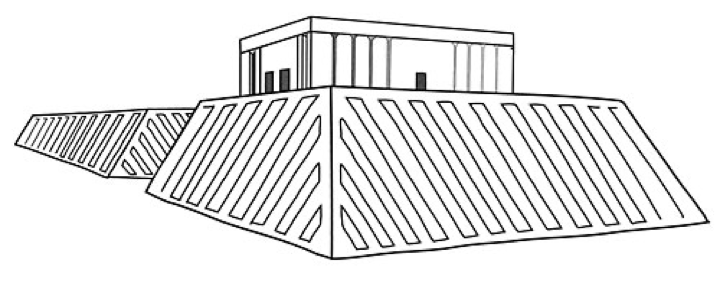
The temple was the house of the god, cared for by priests and scribes. These temples loomed over the city on high platforms known as ziggurats, as shown in the diagram above of Uruk’s temple to Anu. The ziggurat, built of mud-brick, raised the temple high above the flat plain of the city, making it visible from a great distance and closer to the heavens.
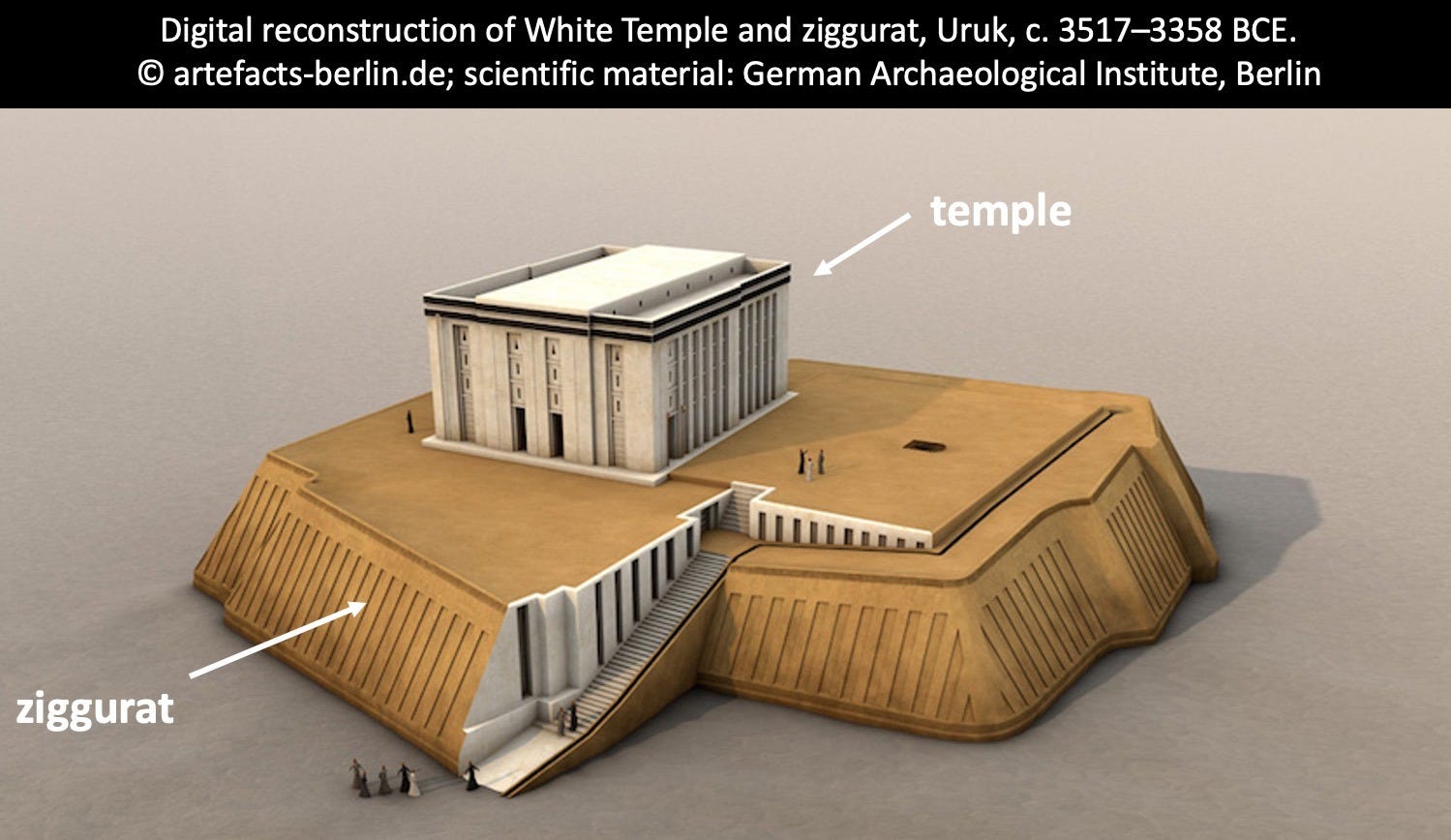
Uruk also had a temple complex dedicated to Inanna, the goddess of fertility. Next week we will explore a special votive offering made around 3300 BCE for her temple.
Paid subscribers may read on for more on Anu’s temple and ziggurat.