
Good Friday Shadows

Tonight’s Good Friday service reminded me of many paintings I have met over the years studying and teaching the history of art. This Easter weekend series presents some of those artworks accompanied by their relevant Bible verses and some commentary.
The Shadow of Betrayal: Matthew 26:20–25
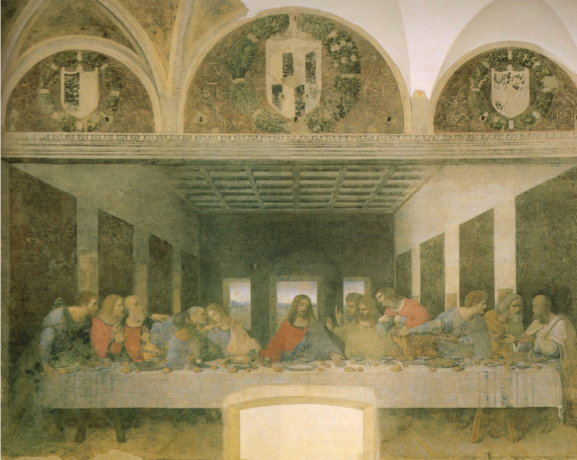
20 When it was evening, Jesus sat at table with the twelve disciples; 21 and as they were eating, he said,
“Truly, I say to you, one of you will betray me.”
22 And they were very sorrowful, and began to say to him one after another, “Is it I, Lord?” 23 He answered, “He who has dipped his hand in the dish with me, will betray me. 24 The Son of man goes as it is written of him, but woe to that man by whom the Son of man is betrayed! It would have been better for that man if he had not been born.” 25 Judas, who betrayed him, said, “Is it I, Master?” He said to him,
“You have said so.”
Long before the Last Supper mural by Leonardo da Vinci was made famous by Dan Brown’s 2003 mystery novel The Da Vinci Code, it was well known by artists and scholars for its inventive approach to a familiar theme—the night Jesus washed the feet of his disciples in an act of humility, predicted his own betrayal, and instituted the Eucharist. Just as the story of Jesus’ final meal with his followers appears in every Gospel,1 a scene of the Last Supper is in every visual representation of the Passion of Christ (the events that took place between his Entry into Jerusalem and his Crucifixion and burial).
How does an artist represent a table scene with thirteen figures? The traditional response is well represented by The Last Supper painted in 1447 by Andrea del Castagno (ca. 1421–1457) for the dining room, or refectory, in the convent of Sant’Apollonia in Florence.
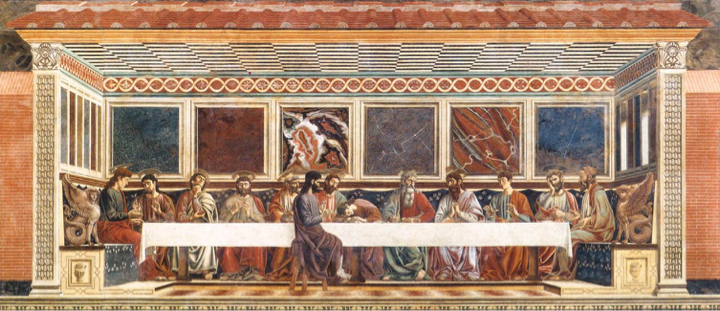
Andrea provided the nuns with an illusion of Jesus and his apostles dining in a raised alcove above the tables filled with the Benedictine nuns who called the convent of Sant’Apollonia their home. The artist has imagined the apostles’ dining room as one fit for a king, decorated with sumptuous marble panels like a royal audience hall. Jesus sits just left of center framed by eleven of his disciples arranged in two neat rows. Only Judas sits on the opposite side of the table, the same side as the viewers, singled out to emphasize his difference from the other disciples and the importance of his role in the story.
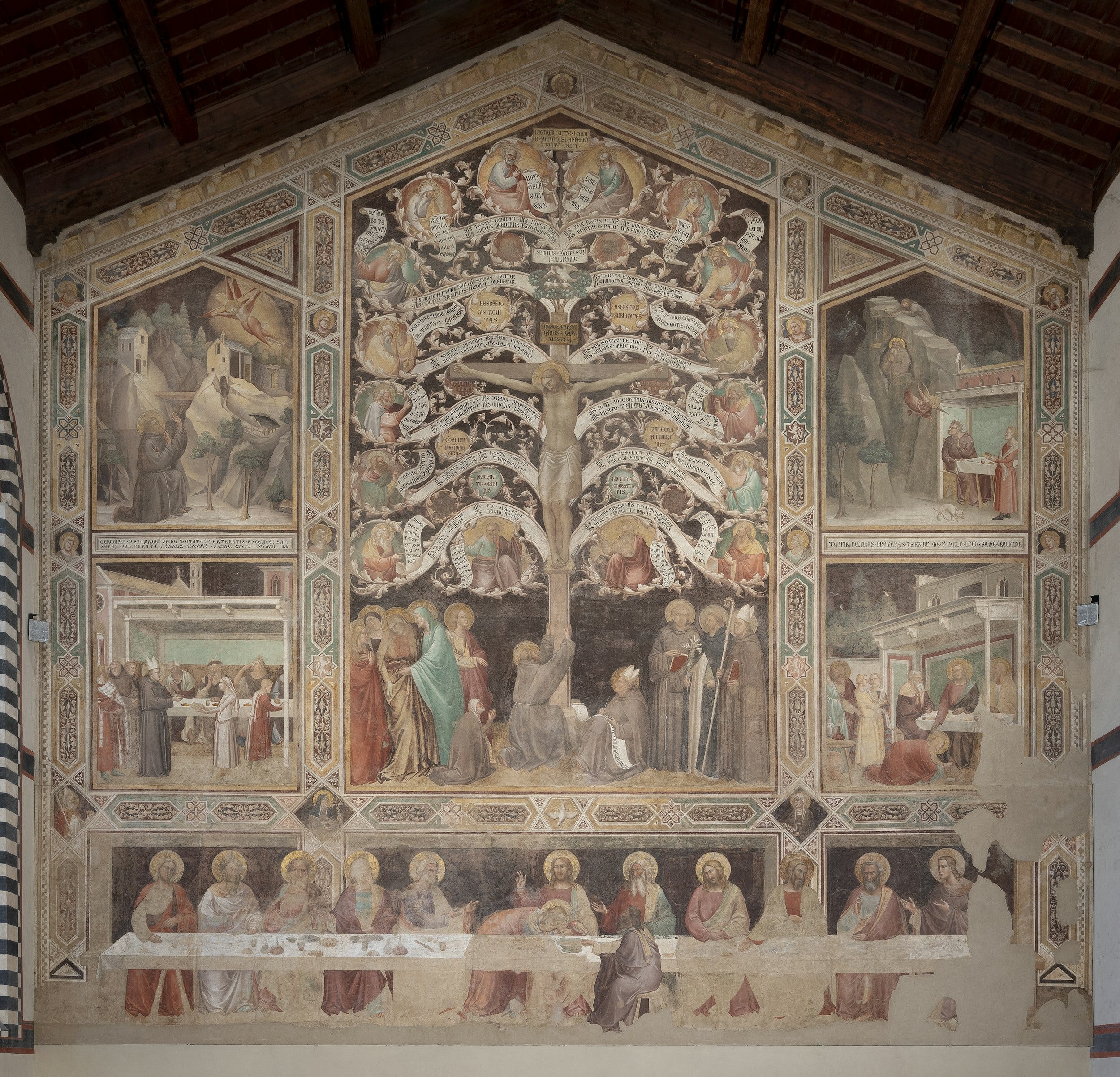
Though the specific decorative details differ, Castagno’s version is not much different from the scene painted by Taddeo Gaddi (active mid-1320s, died 1366) for the refectory of the Franciscan friars of Santa Croce, also in Florence, almost ninety years earlier, around 1360.2
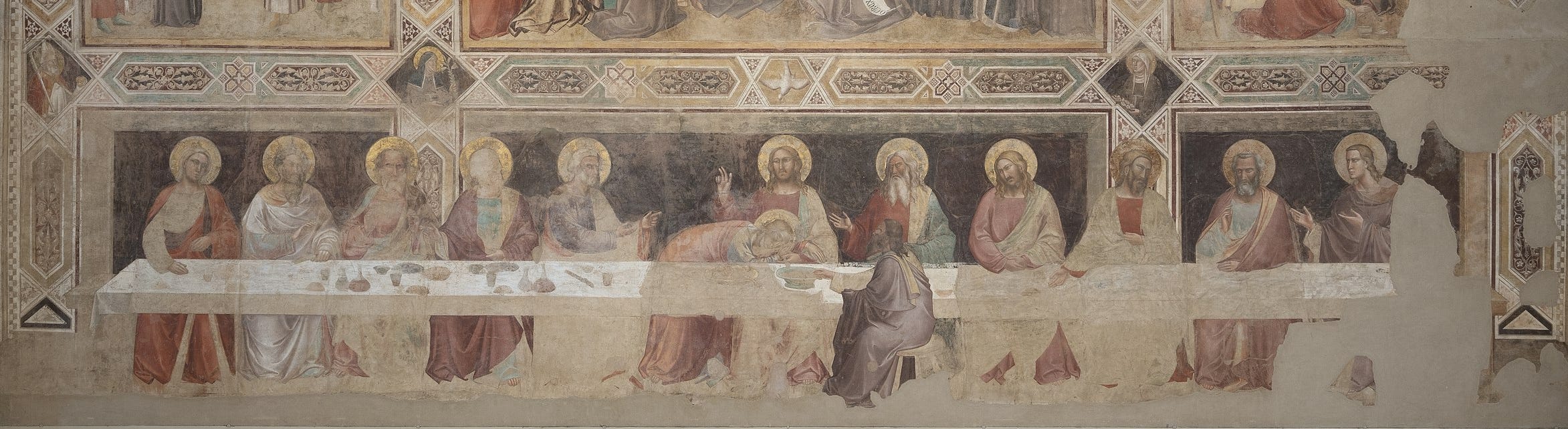
Here we see the long table, the row of apostles, one of whom seems to have had too much wine and fallen asleep on the table,3 and Judas, conveniently sitting alone on the opposite side of the table, almost as if he had come in late from receiving his thirty pieces of silver from the Roman authorities and pulled up a stool to the meal in progress.
Both Taddeo and Andrea have shown each apostle as a separate entity, spaced evenly along the table. The only break in the rhythm is the trio of Jesus, John, and Judas at the center of the scene.
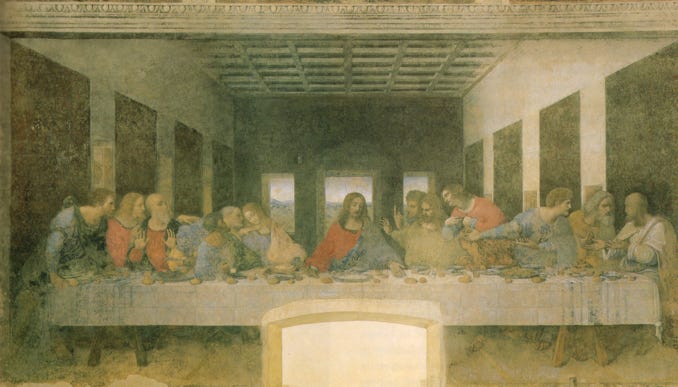
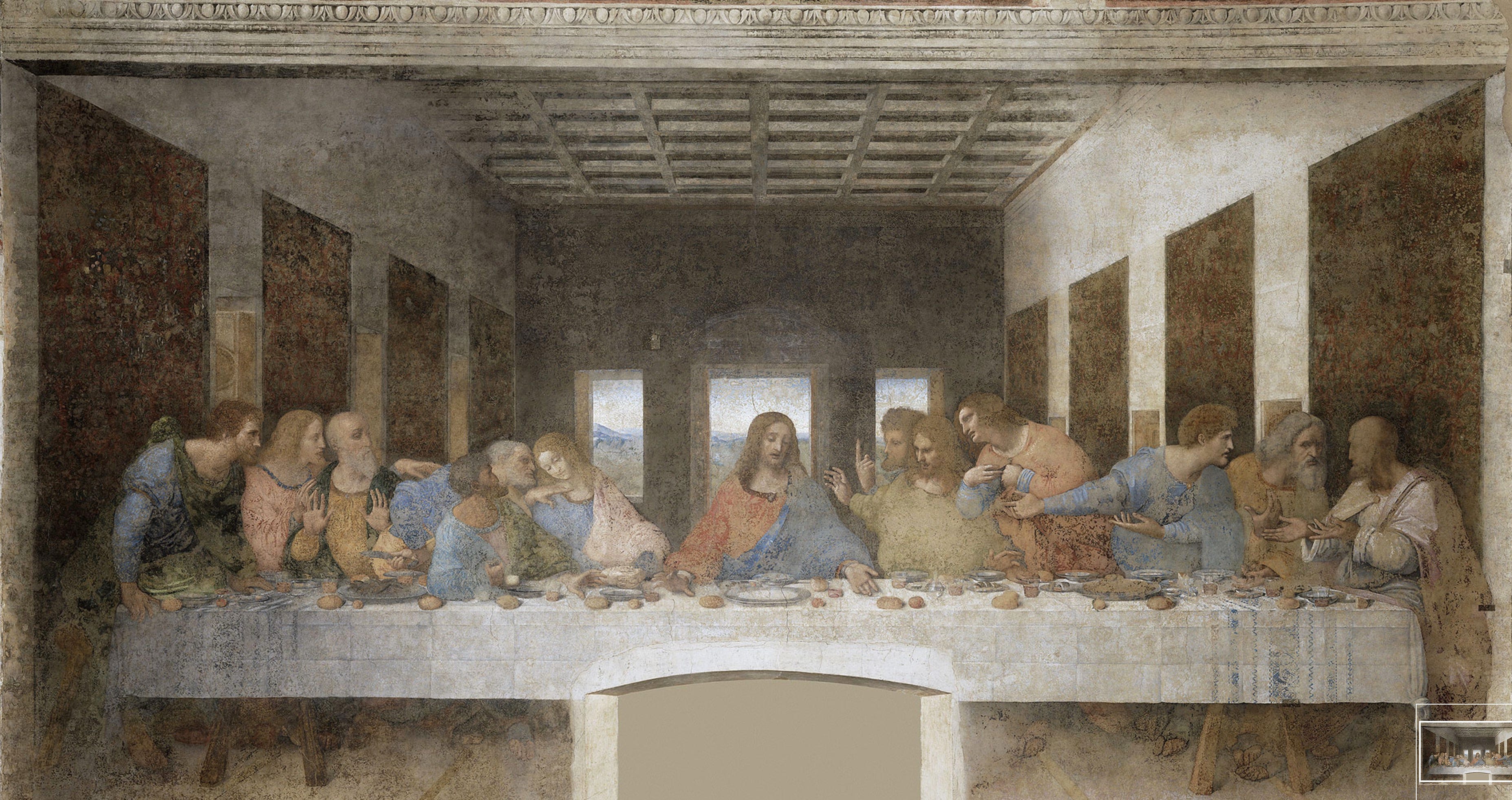
Leonardo’s great innovation is his use of solid and void, the repetition of threes and fours, and a new way of placing the apostles at table.
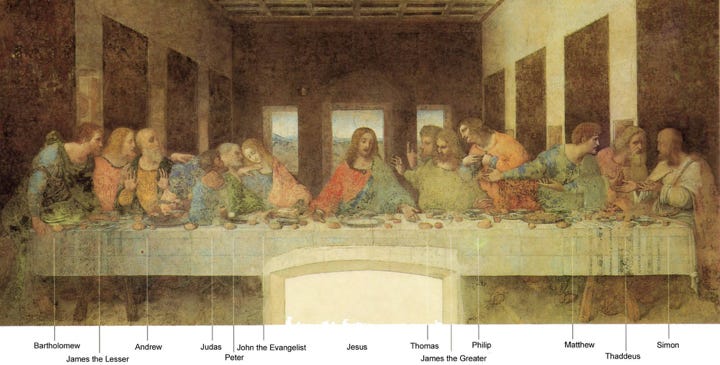
Jesus sits at the long table’s center with his arms outstretched to form a pyramidal shape as the central focus point of the composition. The twelve apostles are now arranged in four groups of three on either side of Jesus rather than disposed in an equally spaced row. Judas no longer sits alone, but forms one of the four triads with Peter and John. More than in the earlier examples, we are clearly at the moment when Jesus has announced that one of his followers will betray him. The apostles react with varying degrees of shock; no two responses are the same. Whether recoiling, leaning in, or talking amongst themselves, the twelve “being very much troubled, began every one to say:
Is it I, Lord?
As Luke recounts in his version of the story (22:21), Jesus tells his dinner companions “the hand of him who is going to betray me is with mine on the table.” Immediately, all recoil from the table, many putting their hands up as if to say:
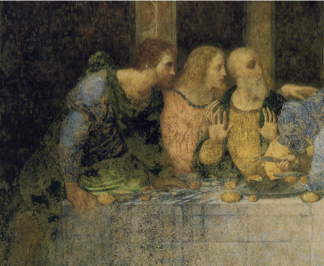
Surely not I, Lord?
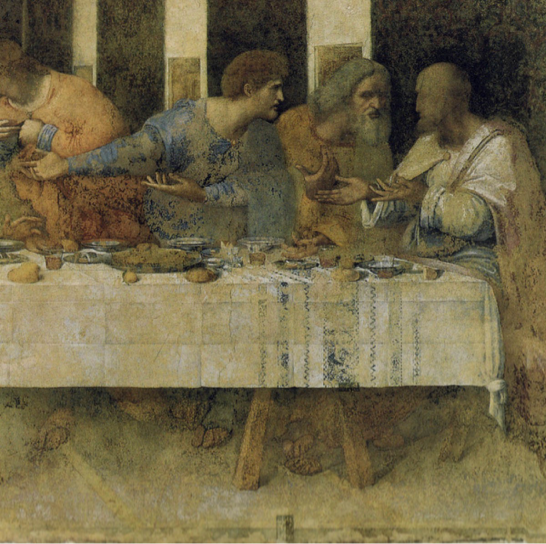
We can almost hear Matthew say to Thaddeus and Simon: Do you hear what he just said? And Simon responds with open hands, Surely he can’t have just said one of us will betray him. Thaddeus between them gestures towards himself, He can’t really have meant what he just said…
Judas, his blue-sleeved elbow on the table, leans away from Jesus, clutching his money bag in his right hand. His left hand hovers over the edge of a dish that Jesus also seems to have just touched, recalling his words as recounted by Matthew “The one who has dipped his hand into the bowl with me will betray me.” (26:23)
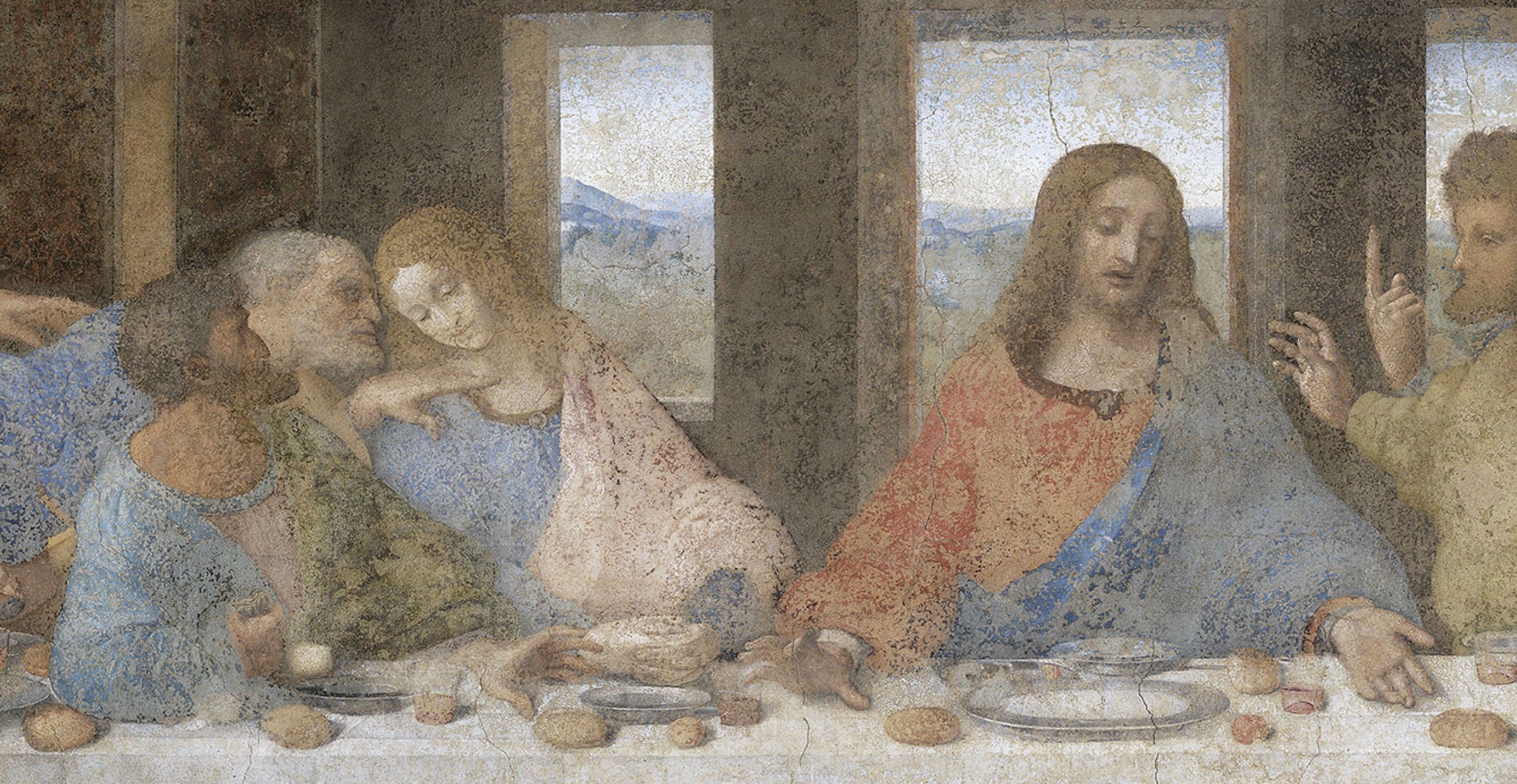
Leo Steinberg published a fascinating study of Leonardo’s mural in 2001, Leonardo’s Incessant Last Supper. His reading of the composition suggests that we are not only seeing the moment of shock and dismay at Jesus’ announcement, but that we are also witnessing Jesus prepare to make his covenant through bread and wine. At the end of his red sleeve, Jesus extends his right hand, which he has just removed from the dish shared with Judas, and reaches for a glass of red wine, the symbol of his blood shed for mankind’s sins. As Luke tells us:4
After taking the cup, he gave thanks and said, “Take this and divide it among you. For I tell you I will not drink again of the fruit of the vine until the kingdom of God comes.”
His open-palmed left hand emerges from his blue mantle, moving towards the bread of which he says: “This is my body given for you; do this in remembrance of me.”
While the disciples are still arguing about the identity of the traitor, Jesus has already moved on, forgiving them all and promising them “I will not eat it again until it finds fulfillment in the kingdom of God.”5
This is Leonardo’s genius. This is why this painting has captivated so many. His one-point linear perspective creates a deep, believable space that focuses our attention on Jesus, the anchor at the center of the chaos. The natural light of the landscape frames his head like a halo. Though Leonardo’s experimental technique of using oil along with tempera ultimately failed, through the damage we can still see the power of this picture. Amid the apostles’ turmoil, we find calm in Jesus.
Mark tells us that after the supper and the promise of both betrayal and salvation, “when they had sung a hymn, they went out to the Mount of Olives.”6 There we will find the next shadow.
Matthew 26:20–29; Mark 14:12–26; Luke 22:7–38; John 13:23–26.
Gaddi’s Last Supper is part of a mural that fills the entire end wall of the refectory at Santa Croce. It is the lowest portion of a complex image in which Gaddi surmounted the Last Supper with a scene of the Crucifixion and framed by the Stigmatization of St. Francis and three other narratives associated with food, in keeping with the room’s function as a dining room. Beneath the fresco, the friars ate in silence, encouraged to meditate, feeding their souls as they fed their bodies. Branches of the Tree of Life spring from the cross that holds Jesus’ body and receives Francis’ embrace. Other important Franciscans, as well as Saint Dominic, stand under the cross, indicating the important role these friar-preachers had in spreading the good news of the Gospel. For more, visit the website of Santa Croce Opera.
It’s John. He’s not drunk, or sleeping, or (heaven forbid!) really Mary Magdalen. He appears to sleep in the bosom of Jesus as a sign of his innocence and trust.
Luke 22:17–18
Ibid., verse 16
Mark 14:26